Localizing Your Website for a New Market
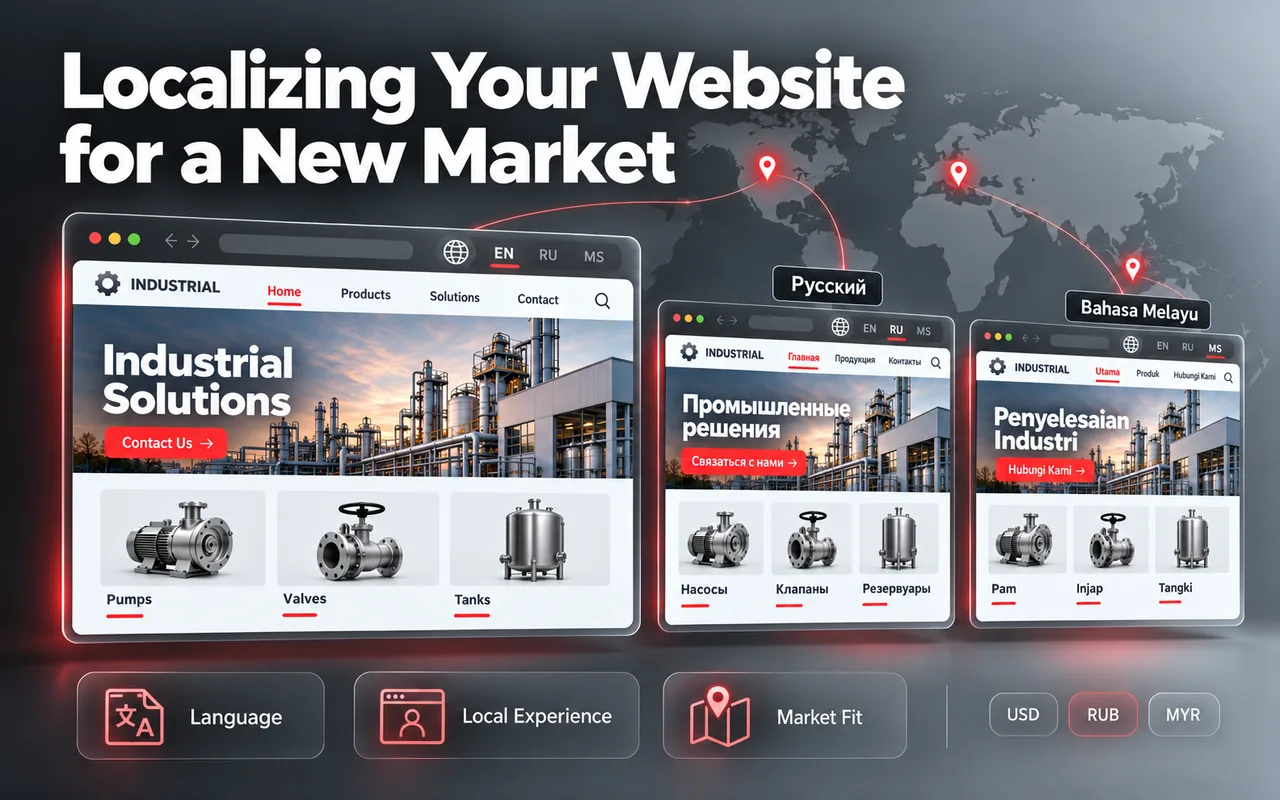
Beyond Translation: How Professional Website Localization and Multilingual Digital Marketing Help Businesses Reach New Customers Worldwide
In this article
- Introduction: Entering a New Market Requires More Than a Translated Website
- Website Localization vs. Translation: Understanding the Difference
- Why Smaller-Language Markets Deserve More Attention
- Our Multilingual Website Localization Services
- Technical SEO for International Websites
- Local Search Advertising: Reaching Buyers in Their Own Markets
- Localized Social Media Marketing
- Multilingual GEO: Preparing Your Business for AI Search
- Industry-Specific Localization for B2B Companies
- Our International Localization and Marketing Process
- Why Work with VALTARIQ?
- Conclusion: Your Next Market Needs More Than a New Language
01Introduction: Entering a New Market Requires More Than a Translated Website
Expanding into international markets creates new opportunities for manufacturers, exporters, and B2B companies. However, entering a new country is not as simple as translating your website into another language.
A website that performs well in the United States may struggle to attract customers in Russia, Poland, Vietnam, Thailand, or other international markets.
Why?
Because different markets have different languages, search habits, digital platforms, cultural expectations, and purchasing behaviors.
Customers in Germany may search for industrial equipment using German technical terminology. Russian buyers may rely on Yandex to discover suppliers. Businesses in South Korea may need to consider Naver alongside Google, while companies targeting China must understand the local search and digital ecosystem.
Successful international expansion requires more than language translation. It requires a localized digital marketing strategy that connects your website, search visibility, advertising campaigns, and customer acquisition process with the behavior of your target market.
At VALTARIQ, we help businesses develop localized websites and multilingual digital marketing strategies for international markets.
Our approach combines website localization, multilingual SEO, local search advertising, social media marketing, and AI search visibility optimization to help companies establish a stronger digital presence in new regions.
Whether you are targeting established European markets or emerging opportunities in smaller-language markets, our objective is to make your business easier for local customers to discover, understand, and contact.
02Website Localization vs. Translation: Understanding the Difference
Many companies believe that creating a multilingual website means translating existing English content into several languages.
Translation is only one part of localization.
Website translation converts text from one language into another.
Website localization adapts the entire website experience to a specific market, including language, terminology, cultural expectations, search behavior, product information, and conversion processes.
Translation vs. localization
- Converts text from one language to another
- Keeps the same structure and keywords
- Local terminology and search behavior
- Cultural expectations and product information
- Conversion processes built for the market
Translation is one part of localization, not a substitute for it.
For example, consider a Chinese manufacturer exporting industrial air compressors.
Its English website may target the keyword:
"Industrial Air Compressor Manufacturer"
However, customers in other markets may search using different terminology:
| Target Market | Local Search Example |
|---|---|
| Russia | Промышленный воздушный компрессор |
| Germany | Industriekompressor |
| France | Compresseur d'air industriel |
| Spain | Compresor de aire industrial |
| Poland | Sprężarka przemysłowa |
| Vietnam | Máy nén khí công nghiệp |
| Indonesia | Kompresor udara industri |
| Turkey | Endüstriyel hava kompresörü |
These are illustrative expressions. Actual commercial keywords must be validated through local keyword research.
Simply translating the English keyword does not guarantee that it matches how local buyers search.
Effective localization requires identifying the terminology customers actually use when researching products, comparing suppliers, and requesting quotations.
This is particularly important in industrial B2B markets, where technical language and purchasing terminology can differ significantly between countries.
03Why Smaller-Language Markets Deserve More Attention
Many international companies focus their marketing budgets on English-speaking markets.
The United States, United Kingdom, and other major English-language markets are important, but they are not the only sources of international business opportunities.
Markets using Russian, Polish, Czech, Hungarian, Romanian, Turkish, Vietnamese, Thai, Indonesian, Arabic, and other languages may offer attractive opportunities for certain products and industries.
However, the potential varies by country, product category, competition, and customer demand.
Opportunities in Local-Language Search
Consider an industrial equipment supplier targeting international customers.
An English-language campaign may compete with numerous global manufacturers.
A localized campaign targeting a specific product category in another language may encounter a different competitive environment.
In some specialized B2B sectors, local-language search campaigns may face less competition than equivalent English-language campaigns.
This possibility should be evaluated using actual keyword volumes, auction data, and conversion performance rather than assumed.
Building Trust with Local Buyers
Local-language websites can help buyers understand technical specifications, product applications, delivery information, and commercial terms.
For complex industrial products, accurate terminology is especially important.
A buyer evaluating transformer testing equipment or manufacturing machinery may need detailed explanations before submitting an inquiry.
Providing these explanations in the buyer's preferred language can reduce unnecessary communication barriers.
Localization is not merely a traffic acquisition technique. It can also support supplier evaluation and improve the clarity of communication throughout the purchasing process.
04Our Multilingual Website Localization Services
At VALTARIQ, our localization approach is designed to help companies build market-specific digital experiences rather than simply publish translated pages.
3.1 Multilingual Website Development
We help businesses plan and develop localized website experiences for their target markets.
Depending on the company's existing website architecture, localization may involve:
- Dedicated language versions
- Country-specific landing pages
- Localized product descriptions
- Multilingual navigation and inquiry forms
- Regional contact and service information
- Technical documentation localization
- Mobile usability improvements
- Localized calls to action
For example, a manufacturer entering the Russian market may benefit from a Russian-language website containing product information, application guides, technical specifications, and an accessible inquiry process.
A company targeting Germany may need German-language technical pages using terminology familiar to industrial procurement professionals.
The goal is to create a website that local customers can use confidently.
3.2 Multilingual SEO
Search engine optimization must account for differences between markets.
Our multilingual SEO approach includes:
Local keyword research
Identifying relevant search terms based on the target country's language and purchasing behavior.
Localized content optimization
Developing page titles, headings, descriptions, and technical content around verified local search intent.
Technical SEO implementation
Reviewing important technical elements such as URL structures, canonical tags, indexing, XML sitemaps, and language targeting.
Competitor analysis
Evaluating relevant local competitors and identifying opportunities to improve content coverage and search visibility.
Localized content development
Creating product guides, application articles, technical explanations, and industry-specific content for the target market.
A multilingual SEO strategy should be developed independently for each important market. Translating the same keyword list into multiple languages is rarely sufficient.
05Technical SEO for International Websites
A multilingual website needs a reliable technical foundation.
Poor international SEO configuration can create duplicate-content confusion, incorrect language targeting, or inconsistent user experiences.
4.1 International URL Structure
Common multilingual website structures include:
Subdirectories
example.com/en/
example.com/de/
example.com/ru/
example.com/fr/
Subdomains
en.example.com
de.example.com
ru.example.com
Country-code domains
example.de
example.fr
example.pl
Each structure has operational advantages and trade-offs.
Subdirectories can simplify centralized management, while country-code domains may provide clearer geographic signaling but require separate operational considerations.
The appropriate choice depends on the company's infrastructure, target markets, and long-term marketing strategy.
4.2 Hreflang Implementation
Google supports hreflang annotations to help identify alternate language or regional versions of a page.
For example:
<link rel="alternate"
      hreflang="en"
      href="https://example.com/en/product/" />

<link rel="alternate"
      hreflang="de"
      href="https://example.com/de/product/" />

<link rel="alternate"
      hreflang="ru"
      href="https://example.com/ru/product/" />

<link rel="alternate"
      hreflang="x-default"
      href="https://example.com/en/product/" />
A correct implementation should include appropriate reciprocal annotations and consistent canonicalization.
Hreflang is not a ranking guarantee, and search engines may interpret international targeting differently.
4.3 Localized Metadata
Every important language version should have appropriate titles and descriptions.
For example:
English:
"Industrial Air Compressor Manufacturer | Example Company"
German:
"Industriekompressoren vom Hersteller | Example Company"
Russian:
"Производитель промышленных воздушных компрессоров | Example Company"
These examples demonstrate localization structure. Final metadata should reflect actual products, verified business claims, and researched local keywords.
4.4 Website Performance and Accessibility
International websites should also account for technical performance across regions.
Important considerations include:
- Server response times
- Content delivery infrastructure
- Mobile compatibility
- Accessible page content
- Secure HTTPS connections
- Local network conditions
- Stable forms and conversion tracking
A localized website must be both linguistically relevant and technically usable. Translation alone cannot compensate for inaccessible pages or broken inquiry forms.
06Local Search Advertising: Reaching Buyers in Their Own Markets
Website localization establishes the foundation, but companies also need strategies to attract relevant visitors.
Search advertising can help businesses reach customers who are actively researching products and suppliers.
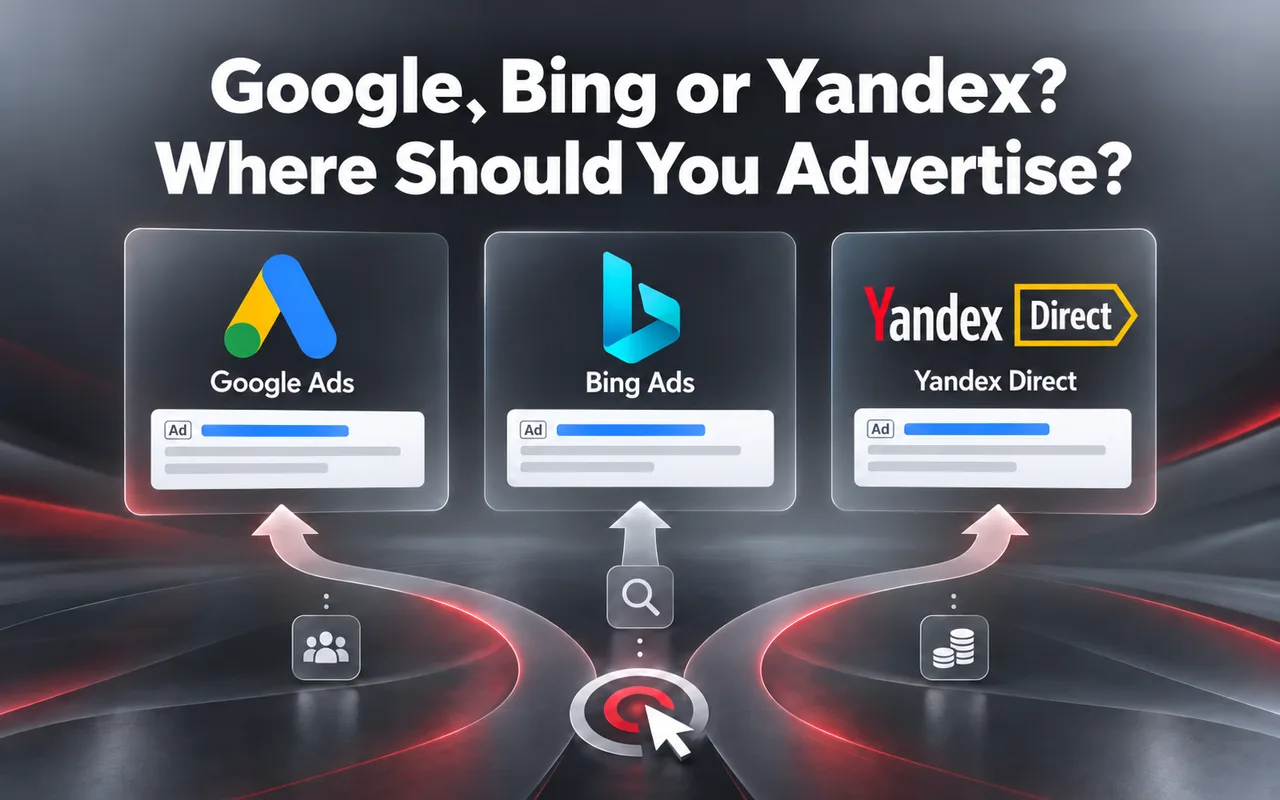
Our international advertising approach considers the platforms that are relevant to each target market.
Platforms differ by market
Platform selection should follow current market research, not a universal formula.
Google Ads
Google Ads can support international search campaigns across many markets and languages.
Potential applications include:
- Industrial product advertising
- Manufacturer and supplier discovery
- B2B lead generation
- Market-specific landing page campaigns
- Remarketing and conversion optimization
Campaigns should be structured according to local demand, product categories, and commercial search intent.
Yandex Direct
For companies targeting Russia, Yandex Direct is an important advertising platform to evaluate.
Potential services include:
- Russian-language keyword research
- Yandex Direct campaign planning
- Search advertisement localization
- Yandex Metrica configuration
- Conversion goal tracking
- Russian-market landing page optimization
Campaign availability, payments, and compliance requirements must be verified for the advertiser and target market.
Microsoft Advertising
Microsoft Advertising can complement Google campaigns in supported markets.
For certain B2B advertisers, it provides an additional opportunity to reach users searching through Microsoft-powered search inventory.
Other Regional Search Platforms
Some markets have distinctive search ecosystems.
For example, Naver is relevant to South Korean search marketing, while Baidu plays an important role in mainland China's search ecosystem.
Platform selection should be based on current market research rather than a universal advertising formula.
We approach international advertising as a market-specific acquisition system, not a single global campaign translated into multiple languages.
07Localized Social Media Marketing
Search engines are not the only way customers discover suppliers.
Social media platforms can influence brand awareness, product research, and customer communication.
However, platform relevance differs significantly between countries.
A marketing strategy that works on Facebook or LinkedIn in one market may not deliver equivalent results in another.
Our localized social media marketing approach can include:
- Market-specific platform research
- Local-language content planning
- Social media advertising strategy
- B2B brand positioning
- Product and application content
- Lead-generation campaign development
- Performance measurement
Example: Russian-Language Markets
VK may be relevant to certain Russian-speaking audiences.
For suitable businesses, a localized marketing strategy can combine search advertising, website content, and social media communication.
Example: European B2B Markets
LinkedIn and search advertising may support professional audience development in selected European markets.
The most suitable platform depends on the target industry and customer profile.
Example: Southeast Asian Markets
Facebook, TikTok, YouTube, and locally popular communication channels may play different roles depending on the country and product category.
Effective localized social media marketing requires understanding where target customers actually spend time and how they evaluate suppliers, rather than automatically using the same platform mix in every country.
08Multilingual GEO: Preparing Your Business for AI Search
International digital marketing is also being influenced by AI-powered search experiences.
Potential customers may use ChatGPT Search, Google AI-powered search features, Perplexity, and other tools to research products and compare suppliers.
This introduces another consideration for multilingual businesses.
Can AI-powered systems discover and accurately interpret your company information in the languages used by your target customers?
What Is Multilingual GEO?
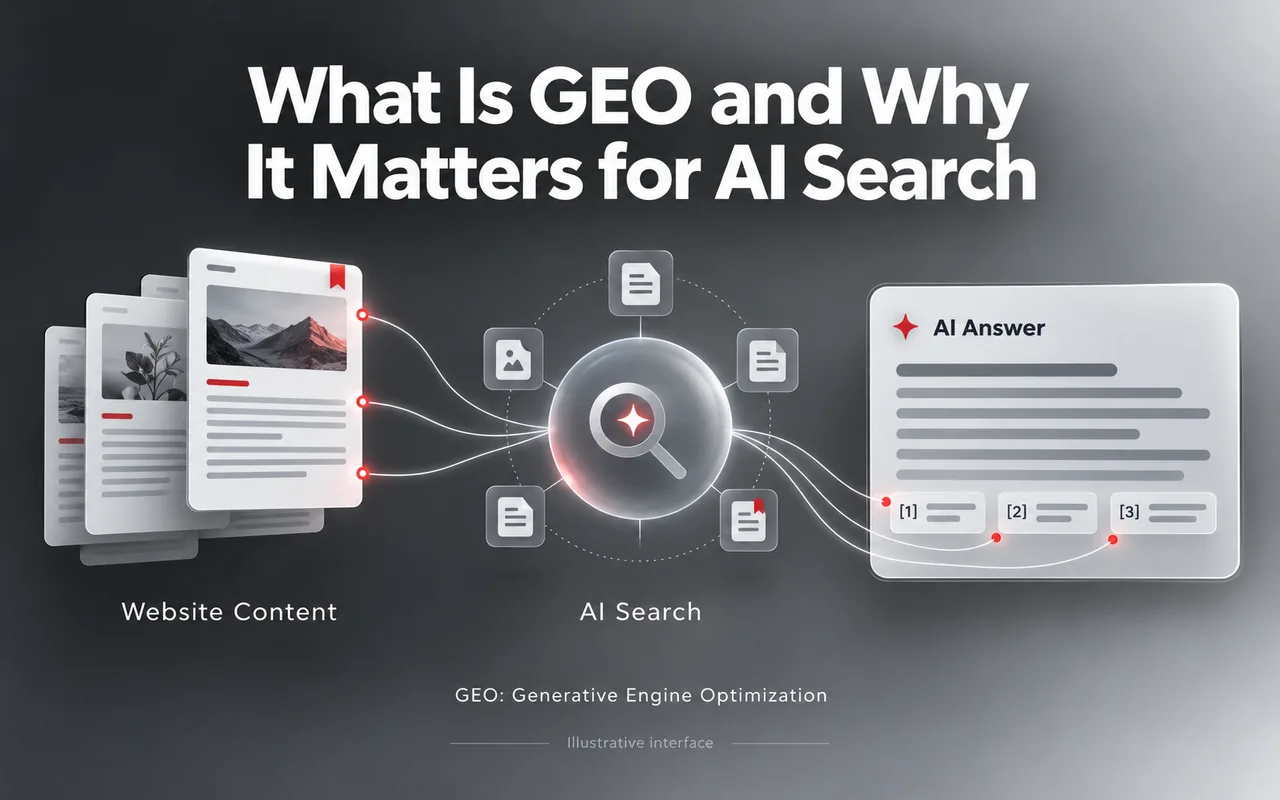
Generative Engine Optimization (GEO) focuses on improving the accessibility, clarity, and verifiability of content that may be used in AI-generated answers.
For international businesses, multilingual GEO extends these principles across languages and markets.
A practical approach includes:
Localized entity information
Consistent company names, product identifiers, and manufacturer relationships across language versions.
Structured technical content
Clear specifications, product descriptions, and application information.
Question-based content
Articles answering common customer questions in the target language.
Verifiable information
Documented technical claims, reliable references, and consistent public information.
AI search monitoring
Testing a predefined set of customer questions to assess whether AI search systems mention the brand, cite relevant sources, or describe products accurately.
Multilingual GEO can be treated as an extension of international SEO and technical content management.
It does not replace search optimization, and no provider can guarantee that an AI system will recommend a particular company.
09Industry-Specific Localization for B2B Companies
Different industries require different localization strategies.
At VALTARIQ, our service approach is particularly relevant to businesses with complex products, specialized buyers, and international sales cycles.
Industrial Machinery and Equipment
Potential localization requirements include:
- Technical product specifications
- Equipment applications
- Maintenance documentation
- Distributor and manufacturer keywords
- Product comparison content
Electrical and Power Testing Equipment
Technical terminology is especially important in electrical engineering.
Relevant product categories may include:
- Transformer testing equipment
- Circuit breaker analyzers
- Relay protection testing systems
- High-voltage testing instruments
- Electrical maintenance equipment
Localized technical content should accurately reflect the product's actual capabilities and applicable standards.
Renewable Energy Equipment
Manufacturers may need market-specific content explaining:
- Product compatibility
- Installation conditions
- Technical performance
- Certifications
- Application environments
- Local commercial requirements
Automotive Products and Accessories
Localization can support distributors, wholesalers, and aftermarket buyers through localized product catalogs, search campaigns, and market-specific commercial content.
Industry-specific terminology and purchasing intent should guide the localization strategy. A generic translation workflow is unlikely to address every technical or commercial requirement.
10Our International Localization and Marketing Process
A structured process helps businesses avoid investing in website translation before understanding the target market.
Seven-step localization process
Step 1: Market Research
We begin by evaluating the target market's search environment, customer behavior, relevant competitors, and available marketing channels.
The goal is to identify commercially relevant opportunities.
Step 2: Localization Strategy
We define the website language structure, priority products, target audiences, and local marketing requirements.
Step 3: Website Localization
We adapt website content, technical terminology, product pages, navigation, and conversion elements.
Step 4: Search Visibility Optimization
We implement appropriate multilingual SEO and technical improvements, including relevant international targeting configurations.
Step 5: Local Advertising Campaigns
We plan and configure eligible search and social advertising campaigns according to the target market.
Step 6: Conversion Tracking
We establish measurable conversion events, such as inquiry submissions, quotation requests, and qualified leads.
Step 7: Continuous Optimization
We review search queries, content performance, lead quality, and available commercial outcomes.
The objective is to build a repeatable international customer acquisition process rather than treat localization as a one-time translation project.
11Why Work with VALTARIQ?
Entering a new market requires coordination between language, technology, content, advertising, and sales.
VALTARIQ focuses on integrating these elements into a market-specific digital marketing strategy.
Multilingual Market Positioning
We help businesses plan localized digital experiences for different international markets, including markets where English-language marketing alone may be insufficient.
Integrated Digital Marketing
Our service approach brings together website localization, SEO, GEO, search advertising, and social media marketing.
B2B-Oriented Content Strategy
We emphasize technical accuracy, product applications, buyer questions, and commercial search intent.
Market-Specific Advertising
We evaluate relevant platforms such as Google Ads, Microsoft Advertising, and Yandex Direct based on the target country's digital environment.
Performance Measurement
We prioritize meaningful conversion signals and qualified inquiries rather than measuring success through website traffic alone.
An integrated approach can help reduce fragmentation between website development, content localization, advertising operations, and lead tracking.
Actual results depend on market demand, competitive conditions, campaign execution, and the company's sales capabilities.
12Conclusion: Your Next Market Needs More Than a New Language
International expansion is not simply about making your website available in more languages.
It is about making your business relevant, understandable, and accessible to customers in different markets.
A localized website should reflect how customers search, what information they need, which platforms they use, and how they prefer to communicate with suppliers.
For manufacturers and B2B exporters, this requires a coordinated strategy covering multilingual website development, international SEO, local advertising, technical content, and conversion optimization.
The strongest international localization strategy connects local market understanding with a technically reliable website and a measurable customer acquisition process.
At VALTARIQ, we help businesses move beyond basic translation and build localized digital marketing systems designed for international growth.
Whether your next target market is Russia, Germany, Poland, Turkey, Vietnam, Thailand, Indonesia, or another region, we can help you evaluate the appropriate localization and marketing approach.
Your products may already be ready for the global market. The next step is making sure local customers can find and understand them.
Expand into New Markets with VALTARIQ
Website Localization | Multilingual SEO | GEO Optimization | Google Ads | Yandex Advertising | International B2B Lead Generation
VALTARIQ — Turning Exposure into Growth.
Search. AI. Media. Technology.
Built for companies going global.
Technical References
- Google Search Central — Managing Multi-Regional and Multilingual Sites
- Google Search Central — Localized Versions of Your Pages
- Google Search Central — AI Features and Your Website
- Google Ads Help
- Yandex Direct Documentation
- Microsoft Advertising Documentation
Editorial note: Platform capabilities and technical principles are based on published documentation. Service descriptions express VALTARIQ's proposed business offerings rather than independently verified delivery records. Market-specific performance claims and results require supporting campaign data.
Want results like this for your brand?
Tell us your market, product and goals. We will reply with a clear plan.
Google, Bing or Yandex: Where Should You Advertise?
What Is GEO and Why It Matters for AI Search