Google, Bing or Yandex: Where Should You Advertise?
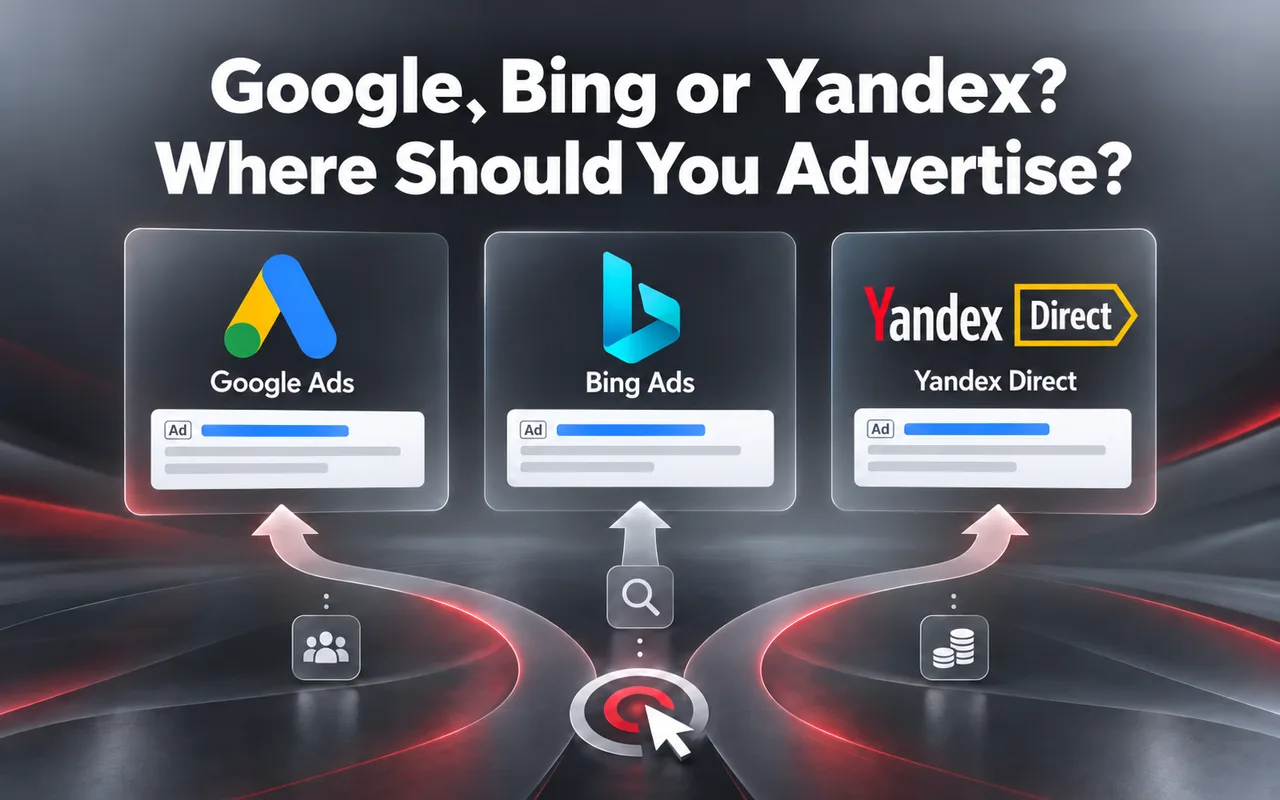
A Technical Guide to Search Advertising, Audience Targeting, Conversion Tracking, and B2B Lead Generation
In this article
- Understanding the Three Advertising Ecosystems
- Google vs. Bing vs. Yandex: Technical Comparison
- Why Search Engine Market Share Is Not Enough
- CPC Is Not the Same as Customer Acquisition Cost
- Keyword Strategy: The Same Product Requires Different Search Structures
- Conversion Tracking: The Foundation of Advertising Optimization
- Landing Page Engineering: Why Advertising Performance Depends on Your Website
- How to Allocate Your Advertising Budget
- A Practical 30-Day Testing Framework
- The Future of Search Advertising: Automation, AI, and First-Party Data
- Conclusion: Google, Bing, or Yandex?
Choosing the right advertising platform is one of the most important decisions in international digital marketing.
For businesses expanding into overseas markets, Google Ads, Microsoft Advertising (formerly Bing Ads), and Yandex Direct represent three different approaches to reaching potential customers through search advertising.
But which platform actually delivers better results?
Is Google always the best choice because of its global reach? Can Microsoft Advertising provide more cost-efficient B2B leads? And should companies targeting Russia prioritize Yandex over Google?
The answer depends on more than search engine market share.
The most effective advertising platform is not necessarily the one generating the most traffic. It is the one capable of delivering qualified customers at an economically sustainable acquisition cost.
To understand where to invest, businesses need to examine five critical factors: geographic coverage, audience behavior, advertising technology, conversion measurement, and actual lead quality.
01Understanding the Three Advertising Ecosystems
Although Google Ads, Microsoft Advertising, and Yandex Direct all support search advertising, their ecosystems, geographic strengths, and targeting capabilities are different.
Google Ads: Global Reach and Advanced Automation
Google Ads allows advertisers to reach users through Google Search and additional inventory such as YouTube, Display, Shopping, and other Google advertising surfaces, depending on campaign type.
Its core advertising capabilities include:
- Keyword-based search advertising
- Responsive Search Ads
- Automated bidding strategies
- Performance Max campaigns
- Audience signals and remarketing
- Offline conversion imports
- Enhanced conversions and first-party measurement
Google Ads is particularly relevant to companies targeting multiple international markets.
For example, a Chinese manufacturer exporting industrial transformers may want to reach procurement teams in Germany, Saudi Arabia, Brazil, and Southeast Asia.
Google Search campaigns can be structured around technical purchasing intent, including queries such as:
- Power transformer testing equipment supplier
- High voltage circuit breaker analyzer manufacturer
- Transformer winding resistance tester price
- Electrical testing equipment distributor
For industrial B2B advertisers, the advantage of Google Ads is not simply traffic volume. It is the ability to capture demand from users actively researching specific products, suppliers, and technical solutions.
However, high-intent industrial keywords may face significant competition. Advertisers should not assume that Google will always provide the lowest cost per qualified lead.
Microsoft Advertising: An Alternative for Professional and B2B Audiences
Microsoft Advertising provides access to Microsoft search advertising inventory, including Bing and applicable search partners. It also supports selected professional-profile targeting capabilities based on LinkedIn profile information, subject to market and campaign availability.
Important features include:
- Search keyword targeting
- Automated bidding
- Importing eligible Google Ads campaigns
- Remarketing
- Conversion tracking through Universal Event Tracking (UET)
- Selected LinkedIn profile-based targeting options
One important distinction is the relationship between Microsoft Advertising and LinkedIn professional data.
Advertisers may be able to adjust targeting using company, industry, or job-function attributes in supported markets.
This can be useful for B2B companies trying to reach engineering firms, industrial distributors, or corporate buyers.
However, Microsoft Advertising is not equivalent to LinkedIn Ads. Its professional targeting features are more limited and should be checked against current market eligibility.
Microsoft Advertising deserves testing when the target audience includes business professionals, enterprise buyers, and desktop-oriented researchers.
It may offer attractive acquisition costs in some markets, but lower CPCs should never be assumed without campaign data.
Yandex Direct: A Search Advertising Platform for Russia
Yandex Direct provides search and advertising-network campaigns within the Yandex ecosystem. Its advertising products include keyword targeting, automated strategies, retargeting, and conversion optimization.
Important capabilities include:
- Search advertising based on user queries
- Advertising across eligible Yandex Advertising Network inventory
- Automated campaign strategies
- Yandex Metrica integration
- Conversion goals and audience segmentation
- Retargeting based on eligible user behavior
For companies targeting customers in Russia, Yandex deserves particular attention.
A manufacturer selling industrial compressors, electrical testing equipment, or machinery into Russia may need campaigns built around Russian-language search behavior.
For example:
- купить испытательное оборудование
- анализатор высоковольтных выключателей
- оборудование для испытания трансформаторов
- промышленный воздушный компрессор
Direct translation from English keywords is rarely sufficient.
Russian buyers may use different technical terminology, product classifications, abbreviations, and purchasing expressions.
Effective Yandex advertising requires localization of the entire acquisition process, including keywords, advertisements, landing pages, inquiry forms, and sales follow-up.
Advertisers must also verify current account eligibility, payment arrangements, applicable sanctions, and local legal requirements before launching campaigns.
02Google vs. Bing vs. Yandex: Technical Comparison
The following comparison summarizes the platforms' general capabilities. Actual availability depends on geography, account eligibility, and campaign type.
| Technical Factor | Google Ads | Microsoft Advertising | Yandex Direct |
|---|---|---|---|
| Primary geographic strength | Broad international coverage | Strong relevance in supported Microsoft search markets | Russia-focused opportunities |
| Search keyword targeting | Yes | Yes | Yes |
| Automated bidding | Yes | Yes | Yes |
| Remarketing | Yes | Yes | Yes |
| Conversion tracking | Google tag, GA4, offline imports | UET, offline conversions | Yandex Metrica, conversion goals |
| B2B targeting opportunity | Search intent and audience data | Search intent plus selected professional targeting | Local search intent and audience segmentation |
| Multilingual campaigns | Broad support | Market-dependent | Particularly relevant to Russian-language campaigns |
| Main strategic limitation | Competition and acquisition costs | Smaller addressable search volume in some markets | More geographically concentrated ecosystem |
The three platforms should not be evaluated using identical assumptions.
Google is often a logical starting point for broad international search demand. Microsoft Advertising can extend coverage and introduce additional audience targeting opportunities. Yandex can be especially relevant for Russian-market acquisition.
The appropriate combination depends on where the company's actual customers search.
03Why Search Engine Market Share Is Not Enough
A common mistake is selecting an advertising platform solely based on search engine market share.
Imagine that a market has the following hypothetical search distribution:
- Google: 75%
- Bing: 15%
- Yandex: 10%
These figures are illustrative, not actual market statistics.
Illustrative search distribution
Google 75% · Bing 15% · Yandex 10%. Hypothetical figures for illustration only, not actual market statistics.
A company might conclude that 75% of its advertising budget should automatically go to Google.
That conclusion is technically weak.
Search market share does not directly measure commercial purchasing intent.
For industrial B2B advertising, the relevant question is:
How much qualified purchasing demand can each platform capture?
Consider two keywords:
"what is a transformer"
and
"110kV transformer testing equipment supplier"
The first query may represent educational research.
The second is more closely aligned with supplier discovery, although purchasing intent still needs to be verified.
An advertising platform generating 1,000 informational clicks may produce fewer qualified opportunities than another generating 100 highly relevant commercial clicks.
Traffic volume is an input metric. Qualified pipeline and customer acquisition economics are the business outcomes that matter.
04CPC Is Not the Same as Customer Acquisition Cost
Many advertisers compare platforms using Cost Per Click (CPC).
This is useful, but incomplete.
A low CPC campaign can still be expensive if visitors rarely become qualified leads.
Consider a hypothetical campaign comparison:
| Metric | Microsoft | Yandex | |
|---|---|---|---|
| Advertising spend | $2,000 | $2,000 | $2,000 |
| Average CPC | $4.00 | $2.50 | $1.25 |
| Clicks | 500 | 800 | 1,600 |
| Inquiries | 25 | 32 | 40 |
| Qualified leads | 10 | 12 | 8 |
| Cost per qualified lead | $200 | $167 | $250 |
All figures are hypothetical and provided only to demonstrate the calculation.
Average CPC
Cost per qualified lead
The lowest CPC is not the lowest cost per qualified lead. Hypothetical campaign data.
At first glance, Yandex appears to be the most efficient platform because it generates the most clicks and the lowest CPC.
However, after measuring lead quality, Microsoft Advertising produces the lowest cost per qualified lead in this example.
The fundamental calculations are:
Cost Per Click
Cost Per Lead
Cost Per Qualified Lead
Customer Acquisition Cost
The final calculation should include relevant marketing and sales acquisition expenses, not just advertising spend.
For B2B exporters, CPQL is often a more informative optimization metric than CPC because inquiry quality can vary substantially between campaigns and markets.
However, qualified leads are still an intermediate outcome. Closed-won customers, revenue, and gross profit provide stronger evidence of commercial performance.
05Keyword Strategy: The Same Product Requires Different Search Structures
One of the most important technical differences between Google, Microsoft Advertising, and Yandex is how advertisers should organize and localize search intent.
Consider an industrial manufacturer selling transformer testing equipment.
Google Ads Keyword Structure
A Google campaign might include three intent groups.
Product keywords
- Transformer turns ratio tester
- Transformer winding resistance tester
- Transformer test equipment
Commercial keywords
- Transformer test equipment manufacturer
- Transformer testing equipment supplier
- Transformer analyzer quotation
Application keywords
- Power transformer maintenance testing
- Substation transformer commissioning
- Transformer diagnostic testing equipment
These groups should be tested separately because their conversion behavior may differ.
Microsoft Advertising Keyword Structure
Microsoft Advertising can start with similar English-language search intent.
However, advertisers should evaluate the platform independently rather than assuming that importing Google campaigns guarantees equivalent performance.
Differences may appear in:
- Search volume
- Auction competition
- Match behavior
- Device distribution
- Audience composition
- Conversion performance
Where available, professional targeting can provide another testing dimension.
For example, advertisers could evaluate relevant industries or company profiles alongside search keywords.
Yandex Keyword Structure
For Yandex, a Russian-language campaign should be built around locally used technical terms.
Examples include:
- прибор для измерения сопротивления обмоток трансформатора
- измеритель коэффициента трансформации
- испытательное оборудование для подстанций
- диагностика силовых трансформаторов
Keyword research should distinguish between buyers looking for equipment, services, technical information, and repair solutions.
A well-localized Yandex campaign is not simply an English Google campaign translated into Russian.
It should be treated as a separate market research and advertising engineering project.
06Conversion Tracking: The Foundation of Advertising Optimization
Advertising platforms cannot reliably optimize toward business outcomes unless advertisers provide meaningful conversion signals.
For B2B exporters, this is particularly important because the purchase process may take weeks or months.
A customer might:
- Search for a product.
- Visit a technical product page.
- Download a catalog.
- Submit an inquiry.
- Communicate with the sales team.
- Request a quotation.
- Complete a purchase several months later.
If the advertiser only measures website form submissions, the advertising system cannot directly distinguish serious procurement opportunities from low-quality inquiries.
Google Ads Tracking Architecture
A typical implementation may include:
Useful conversion events include:
- Contact form submission
- RFQ submission
- Catalog request
- Qualified lead
- Sales opportunity
- Closed-won customer
Google Ads supports offline conversion workflows that can connect eligible advertising interactions to subsequent business outcomes.
Microsoft Advertising Tracking Architecture
A comparable setup can use:
UET helps record eligible website interactions and conversion activity.
Offline conversion data can supplement website measurement when properly configured.
Yandex Direct Tracking Architecture
For Yandex, a typical setup uses:
Yandex Metrica can track website interactions and configured goals.
Where supported and correctly implemented, CRM-based conversion information can help advertisers evaluate downstream outcomes.
The best technical architecture connects advertising data to CRM outcomes across all three platforms.
This enables advertisers to evaluate not only which platform produces inquiries, but which campaigns generate real sales opportunities.
Tracking must be implemented in accordance with applicable privacy laws, consent requirements, and each platform's data policies.
07Landing Page Engineering: Why Advertising Performance Depends on Your Website
Even a well-optimized advertising campaign can fail if the landing page does not answer the visitor's questions.
For industrial B2B advertising, a useful landing page should provide more than a product image and a generic contact form.
It should include:
Technical specifications
Voltage range, accuracy, testing standards, measurement capabilities, interfaces, and operating conditions.
Application scenarios
Explain where the equipment is used, such as substations, power plants, electrical maintenance projects, or industrial facilities.
Product evidence
Include verifiable certifications, manuals, technical documents, testing information, and relevant application cases.
Commercial information
Clarify manufacturing capabilities, customization options, delivery considerations, and available sales support.
Conversion opportunities
Provide clear RFQ forms, contact options, and technical consultation requests.
The website should also be technically accessible.
Important engineering considerations include mobile usability, page performance, secure HTTPS delivery, crawlable content, and correct analytics implementation.
The landing page acts as the connection between search intent and sales qualification.
Advertising can bring a potential customer to the website, but the website must provide enough reliable information to move the purchasing process forward.
08How to Allocate Your Advertising Budget
There is no universally correct percentage for Google, Microsoft Advertising, and Yandex.
Budget allocation should depend on target markets, available search demand, acquisition costs, and the company's ability to convert leads into customers.
The following are illustrative starting frameworks, not statistically validated optimal allocations.
Scenario A: Exporting to Multiple International Markets
For a manufacturer targeting Europe, the Middle East, and Southeast Asia:
- Google Ads: 70%
- Microsoft Advertising: 20%
- Experimental campaigns: 10%
This allocation may provide a practical starting point for testing Google as the primary acquisition channel while evaluating Microsoft Advertising.
It should be adjusted using actual conversion and CRM data.
Scenario B: Targeting the Russian Market
For a manufacturer primarily pursuing customers in Russia:
- Yandex Direct: 70%
- Other eligible advertising channels: 20%
- Testing and optimization reserve: 10%
Prioritizing Yandex may be appropriate where Russian-language search demand is concentrated in its ecosystem.
Actual budget decisions require current market data and confirmation that the business can legally and operationally use each channel.
Scenario C: Targeting Enterprise B2B Buyers
For a company targeting professional buyers in markets supported by both Google and Microsoft Advertising:
- Google Ads: 55%
- Microsoft Advertising: 35%
- Experimental budget: 10%
This structure provides additional room to evaluate Microsoft Advertising's search and professional audience capabilities.
It should not be interpreted as evidence that Microsoft Advertising will outperform Google for enterprise customers.
Illustrative budget starting points
Starting hypotheses to adjust with conversion and CRM data, not validated optimal allocations.
09A Practical 30-Day Testing Framework
Rather than choosing a platform based on assumptions, companies can run a controlled advertising experiment.
30-day testing plan
Week 1: Build the Measurement Infrastructure
Define qualified leads, configure conversion tracking, establish CRM lead statuses, and create market-specific landing pages.
Confirm that advertising clicks can be connected to meaningful downstream outcomes.
Week 2: Launch High-Intent Search Campaigns
Start with narrowly defined commercial keywords.
Separate campaigns by country, language, and product category.
Avoid mixing unrelated purchasing intentions into the same reporting group.
Week 3: Evaluate Search Quality
Review search terms, irrelevant traffic, landing page engagement, conversion quality, and early sales feedback.
Refine negative keywords and exclude irrelevant traffic where supported.
Do not optimize solely for cheaper clicks.
Week 4: Compare Commercial Outcomes
Evaluate each platform using consistent metrics:
- Advertising spend
- Qualified leads
- Cost per qualified lead
- Sales-accepted leads
- Opportunities created
- Pipeline value, where measurable
For industrial B2B companies, 30 days may be insufficient to measure final customer acquisition or revenue because of long sales cycles.
The initial test should therefore be treated as an early-stage assessment, followed by longer-term CRM measurement.
Budget should be increased only when performance evidence is sufficiently reliable. Small sample sizes, attribution differences, and delayed conversions can make early results misleading.
10The Future of Search Advertising: Automation, AI, and First-Party Data
Search advertising is evolving beyond traditional keyword bidding.
Google, Microsoft, and Yandex have all introduced automation capabilities that can assist with campaign delivery, bidding, and creative workflows.
However, automation does not eliminate the need for accurate business information.
An automated campaign still depends on the quality of its inputs, including conversion signals, product information, audience constraints, and landing page content.
For B2B advertisers, this creates an important technical requirement:
Build a reliable data connection between product information, advertising systems, website behavior, and sales outcomes.
A practical architecture is:
This structure supports more meaningful optimization than treating advertising as an isolated traffic acquisition activity.
As advertising systems become increasingly automated, the quality of first-party business data may become a more important competitive advantage.
A company with reliable product information and accurate sales conversion data is better positioned to evaluate and improve automated advertising than one measuring clicks alone.
11Conclusion: Google, Bing, or Yandex?
The right advertising platform depends on the market you want to reach and the customers you want to acquire.
Google Ads offers extensive international advertising coverage and automation capabilities.
Microsoft Advertising provides another search advertising ecosystem, including selected professional audience targeting options.
Yandex Direct offers search and advertising-network capabilities relevant to businesses targeting Russia.
For companies pursuing broad international demand, Google is often a reasonable first platform to evaluate. Microsoft Advertising can provide additional reach and targeting opportunities. For Russian-language acquisition, Yandex should be evaluated as a major channel rather than treated as an afterthought.
But choosing a platform is only the beginning.
Successful international advertising requires coordinated keyword research, localization, conversion measurement, technical landing pages, and sales qualification.
The real question is not whether Google, Bing, or Yandex is the best advertising platform.
It is which platform can consistently turn your advertising investment into qualified business opportunities and profitable customers.
Official Technical References
The following documentation provides implementation guidance and platform feature details. Availability and requirements should be verified before campaign deployment.
- Google Ads Help — Campaign configuration, bidding, conversion measurement, and optimization.
- Google Ads API Documentation — Programmatic campaign management and reporting.
- Microsoft Advertising Documentation — Campaign management, UET, targeting, and API integration.
- Yandex Direct Help — Campaign configuration and advertising tools.
- Yandex Metrica Documentation — Analytics, conversion goals, and website measurement.
Editorial note: This article distinguishes documented platform capabilities from strategic analysis and hypothetical recommendations. Advertising costs, market shares, and campaign performance are not presented as current measured benchmarks.
Want results like this for your brand?
Tell us your market, product and goals. We will reply with a clear plan.
What Is GEO and Why It Matters for AI Search
Localizing Your Website for a New Market