
What Is GEO and Why It Matters for AI Search
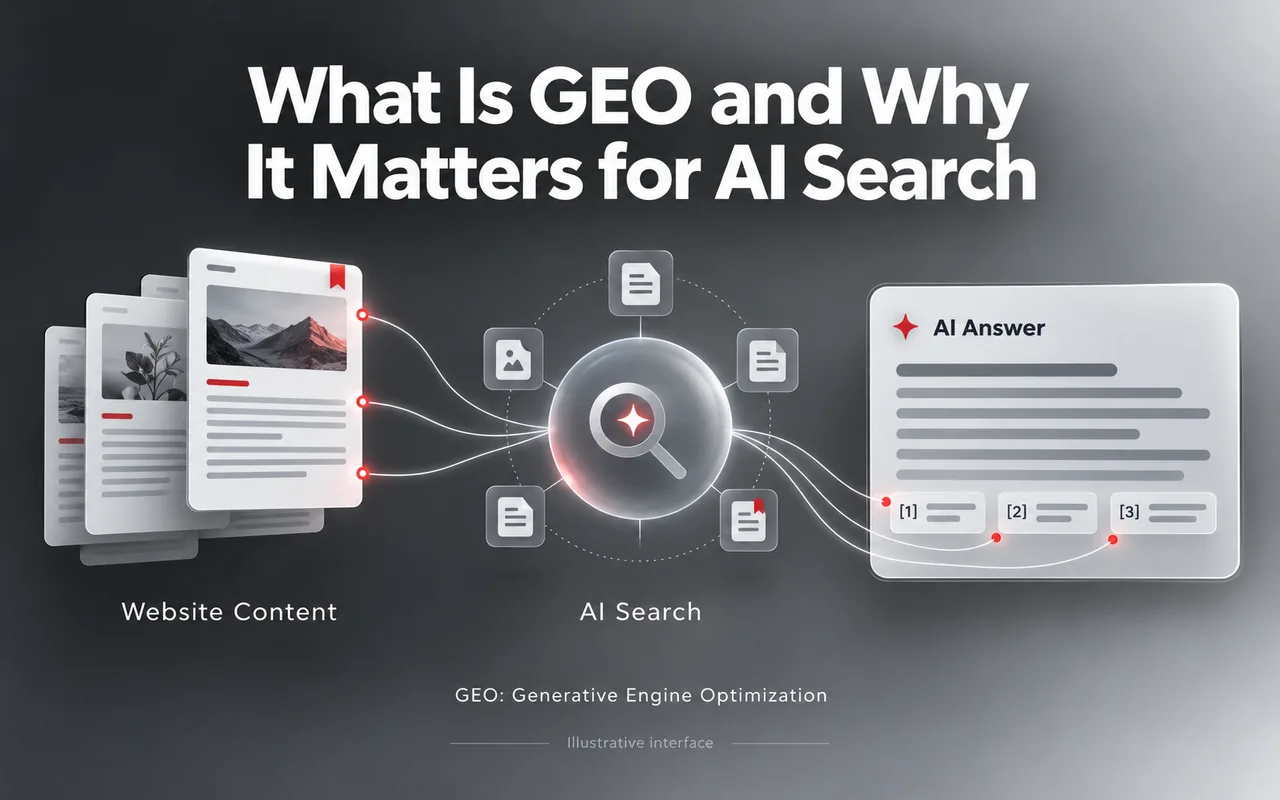
A Technical Guide to Generative Engine Optimization, AI Search Visibility, and the Future of Digital Marketing
In this article
- Introduction: Search Is Changing from Links to Answers
- What Is Generative Engine Optimization (GEO)?
- GEO vs. SEO: What Is the Technical Difference?
- How AI Search Engines Discover and Generate Answers
- The Technical Foundation of GEO: Crawlability, Indexing, and Rendering
- Entity Optimization: Helping AI Understand Your Business
- Answer-First Content: Writing for Questions, Not Just Keywords
- Why Evidence and Third-Party Sources Matter
- GEO for B2B Manufacturers: A Practical Example
- How to Measure GEO Performance
- Building a GEO Monitoring System
- Common GEO Mistakes Businesses Should Avoid
- The Future of GEO: From Search Visibility to AI-Readable Business Knowledge
- Conclusion: GEO Is About Becoming a Reliable Source for AI Search
- Technical References and Further Reading
01Introduction: Search Is Changing from Links to Answers
For more than two decades, Search Engine Optimization (SEO) has been one of the foundations of digital marketing.
Businesses optimized their websites for search engines, competed for keyword rankings, built backlinks, and measured success through organic traffic.
The traditional search model was relatively straightforward:
However, generative artificial intelligence is introducing another way for users to discover information.
AI-powered search experiences, including Google AI Overviews, Google AI Mode, ChatGPT Search, and Perplexity, can synthesize information from multiple sources and present an answer directly to the user.
Instead of opening several websites to compare information, users may receive a summarized explanation with supporting citations or links.
This creates an important question for businesses:
What happens when potential customers discover products, compare suppliers, and evaluate solutions through AI-generated answers rather than traditional search results?
This is where Generative Engine Optimization (GEO) becomes relevant.
GEO represents an extension of search optimization: from competing for positions in search results to improving the likelihood that accurate, verifiable business information can be discovered, understood, and used by AI-powered search systems.
Understanding GEO requires more than learning a new marketing term. It requires examining how AI search retrieves information, processes evidence, identifies entities, and constructs answers.
02What Is Generative Engine Optimization (GEO)?
Generative Engine Optimization refers to approaches intended to improve the visibility of content within responses generated by AI-powered information retrieval systems.
The term gained research attention through the paper GEO: Generative Engine Optimization, which investigated methods for improving content visibility in generative engine responses.
Unlike traditional SEO, which primarily focuses on improving the discoverability and ranking of web pages in search results, GEO examines how information is represented within generated answers.
For example, consider a user searching for:
"Best transformer testing equipment manufacturers for power utilities"
A traditional search engine may return a list of relevant manufacturers, distributors, and technical articles.
An AI-powered search system may instead produce a synthesized response describing different equipment categories, manufacturers, technical specifications, and purchasing considerations.
The response may include links or citations to supporting sources.
For a manufacturer, the challenge is no longer limited to appearing on the first page of search results.
The company must also consider whether AI systems can accurately identify its products, understand their technical capabilities, and associate the company with relevant purchasing questions.
A Practical Definition of GEO
Generative Engine Optimization is the process of improving the accessibility, clarity, factual reliability, and external verifiability of digital information so that AI-powered search systems can more effectively retrieve and represent it in relevant answers.
This definition highlights four important dimensions:
- Accessibility: Can the system discover and access the content?
- Understandability: Can it identify the entities, products, specifications, and relationships described?
- Verifiability: Are important claims supported by evidence?
- Relevance: Does the information answer the user's actual question?
These dimensions provide a practical foundation for developing a GEO strategy.
However, no optimization technique can guarantee inclusion, citation, or recommendation in AI-generated answers.
03GEO vs. SEO: What Is the Technical Difference?
SEO and GEO share several technical foundations, but their optimization objectives are not identical.
Traditional SEO focuses on helping search engines crawl, index, interpret, and rank web content.
GEO adds another consideration: how information may be retrieved and synthesized when an AI system generates an answer.
| Dimension | Traditional SEO | GEO |
|---|---|---|
| Primary objective | Improve organic search visibility | Improve visibility and accurate representation in AI-generated answers |
| Typical output | Ranked links and search features | Generated answers, citations, and source links |
| Content emphasis | Search intent, relevance, page quality | Direct answers, factual clarity, evidence, and relevance |
| Technical foundation | Crawling, indexing, rendering | Accessible retrieval sources and interpretable content |
| Authority signals | Links, reputation, content quality | Source reliability, corroboration, and relevance |
| Measurement | Rankings, impressions, clicks | Mentions, citations, answer accuracy, referral traffic |
| Main limitation | Rankings do not guarantee clicks | Visibility and citations cannot be guaranteed |
Google states that its AI search features build upon existing Search systems and that established SEO best practices remain relevant. Google does not require a separate special schema or AI-specific file for eligibility in its AI search features.
Therefore, GEO should not be treated as a complete replacement for SEO.
A more useful technical model is: SEO establishes discoverability, while GEO extends optimization toward answer-level representation and evidence quality.
How SEO and GEO relate
SEO establishes discoverability. GEO extends it toward answer-level representation and evidence quality.
A website with serious crawling or indexing problems may struggle to participate in search experiences that depend on that content.
Similarly, a technically accessible website may still provide insufficient information for an AI system to accurately explain its products.
Both problems require attention.
04How AI Search Engines Discover and Generate Answers
To understand GEO, it is necessary to examine the underlying information retrieval process.
Not every AI search engine uses the same architecture. Some combine web search with language models, while others use proprietary retrieval, ranking, and generation systems.
Nevertheless, a retrieval-augmented generation (RAG) architecture provides a useful conceptual model.
A conceptual RAG pipeline
A simplified model. Actual retrieval and citation systems differ across products.
Stage 1: Query Understanding
When a user submits a question, an AI-powered search system may analyze the underlying intent rather than relying exclusively on the exact wording.
Consider the query:
"Which transformer testing equipment is suitable for substation maintenance?"
The system may identify several information requirements:
- Transformer testing methods
- Equipment categories
- Substation maintenance applications
- Relevant technical standards
- Measurement capabilities
- Equipment selection criteria
Google has publicly described query fan-out in its AI search experiences, where multiple related searches may be performed to address different aspects of a complex question.
However, the exact retrieval and reasoning procedures vary across products and are not fully public.
Stage 2: Information Retrieval
The system may retrieve relevant information from search indexes, accessible web pages, or other available data sources.
Potential sources include:
- Manufacturer product pages
- Technical documentation
- Industry publications
- Research papers
- Product specifications
- Standards-related explanations
- Independent technical comparisons
At this stage, content accessibility and relevance become important.
If a product page is inaccessible, blocked, poorly rendered, or missing essential information, a retrieval system may have difficulty using it.
Stage 3: Source Selection and Context Construction
Retrieved material may be evaluated, filtered, or ranked before being passed to a language model.
In a typical RAG system, relevant passages are assembled into a context that supports answer generation.
The selection process may consider semantic relevance, document quality, source reliability, and other system-specific factors.
This is one reason why a well-structured technical page can be more useful than a page containing repeated keywords but little substantive information.
Stage 4: Answer Generation
The language model uses available context and its other capabilities to construct a response.
Depending on the system, it may summarize findings, compare alternatives, explain technical concepts, and include source links.
The generated response is not necessarily a direct quotation from any individual source.
This distinction matters because a brand may be mentioned without a citation, cited without a prominent brand mention, or omitted entirely.
Stage 5: Citation and Presentation
Some AI search products display supporting citations or links.
However, citation selection and presentation vary by platform.
A retrieved source is not guaranteed to appear as a visible citation.
Likewise, a citation does not necessarily mean the system endorses every statement on the cited page.
GEO should therefore evaluate multiple outcomes separately: retrieval accessibility, brand mentions, factual accuracy, citations, and actual business engagement.
05The Technical Foundation of GEO: Crawlability, Indexing, and Rendering
Before optimizing content for AI-generated answers, businesses should ensure that their websites can be accessed and understood by relevant search and retrieval systems.
4.1 Robots.txt and Crawler Access
The robots.txt file communicates crawling preferences to compliant automated crawlers.
For example:
User-agent: *
Allow: /

Sitemap: https://example.com/sitemap.xml
This example permits compliant crawlers to access the site and provides a sitemap location.
However, crawler behavior depends on the service.
Different AI-related products may use different crawlers for search discovery, training-related collection, or user-requested page access.
For example, OpenAI documents separate crawler and user-agent categories, including OAI-SearchBot for search-related discovery and GPTBot for model-training-related crawling.
These functions should not be treated as identical.
Crawler access controls and their effects are service-specific. Allowing a crawler does not guarantee indexing, retrieval, or inclusion in an AI-generated answer.
4.2 XML Sitemaps
An XML sitemap helps search engines discover important URLs.
A basic example:
<?xml version="1.0" encoding="UTF-8"?>
<urlset xmlns="http://www.sitemaps.org/schemas/sitemap/0.9">
  <url>
    <loc>https://example.com/products/transformer-tester</loc>
  </url>
</urlset>
For industrial manufacturers, important URLs may include product pages, application guides, technical articles, and documentation.
Sitemaps are discovery aids, not guarantees of indexing.
4.3 Server-Side Rendering
JavaScript-heavy websites may introduce content accessibility challenges for crawlers that do not execute JavaScript or render pages in the same way as modern browsers.
Server-side rendering or pre-rendering can help ensure that essential content is available in the initial HTML response.
For example:
<main>
  <h1>Transformer Winding Resistance Tester</h1>

  <p>
    Equipment designed to measure winding resistance
    during transformer maintenance and testing.
  </p>

  <section>
    <h2>Technical Specifications</h2>
    <p>Measurement range: See product datasheet.</p>
  </section>
</main>
This approach makes the page's core subject and technical context visible without requiring client-side interaction.
A practical GEO technical audit should verify that important product information is present in accessible HTML and is not hidden behind scripts, authentication barriers, or unsupported interactions.
06Entity Optimization: Helping AI Understand Your Business
One of the most important concepts in modern information retrieval is the entity.
An entity is an identifiable thing, such as a company, product, person, organization, location, or technical concept.
For example:
- Company: An industrial testing equipment manufacturer
- Product: Transformer winding resistance tester
- Application: Power transformer maintenance
- Industry: Electrical power systems
- Technical standard: An applicable IEC or IEEE standard
The relationships between these entities help describe what a company actually does.
Consider the following structure:
This is a simplified entity relationship model.
A website should communicate these relationships through clear, consistent information.
Structured Data with JSON-LD
Schema.org structured data can help eligible search systems interpret explicitly described information.
Example:
<script type="application/ld+json">
{
  "@context": "https://schema.org",
  "@type": "Product",
  "name": "Transformer Winding Resistance Tester",
  "description": "Electrical testing equipment for measuring transformer winding resistance.",
  "category": "Electrical Test Equipment",
  "brand": {
    "@type": "Brand",
    "name": "Example Industrial"
  },
  "manufacturer": {
    "@type": "Organization",
    "name": "Example Industrial"
  }
}
</script>
This markup describes the product and its manufacturer.
It should accurately reflect visible page content.
Structured data can help search engines understand content and may support eligible search features. However, adding Schema.org markup does not guarantee that a product will be mentioned or cited in AI-generated answers.
The value of entity optimization comes from improving factual consistency across product pages, company descriptions, technical documents, and credible external references—not from inserting structured data alone.
07Answer-First Content: Writing for Questions, Not Just Keywords
Traditional SEO content often begins with a target keyword and builds an article around it.
GEO-oriented content engineering places greater emphasis on directly answering a specific user question.
Consider the question:
"What is the difference between transformer winding resistance testing and insulation resistance testing?"
A weak answer might say:
"Transformer testing is very important. Our company provides advanced transformer testing equipment with excellent quality and competitive prices."
This does not explain the technical difference.
A stronger answer would be:
"Transformer winding resistance testing measures the electrical resistance of transformer windings to help identify issues such as poor connections or winding-related abnormalities. Insulation resistance testing evaluates insulation resistance between conductors and ground or between relevant winding circuits. The two tests examine different electrical properties and are used for different diagnostic purposes."
The second answer is more useful because it provides a direct technical distinction.
A Practical Content Structure
A GEO-oriented technical page can follow this format:
For example:
Question: What is a transformer turns ratio tester?
Direct answer: A transformer turns ratio tester measures the relationship between transformer winding ratios to help verify expected transformation characteristics.
Technical explanation: Explain the measurement principle, relevant operating considerations, and interpretation of results.
Supporting evidence: Provide equipment specifications, relevant standards, documentation, and appropriate references.
Application: Explain how the instrument is used during commissioning, maintenance, or troubleshooting.
This structure improves human readability and makes important facts easier to locate and interpret in retrieval-based systems.
It is not a guaranteed ranking or citation technique, but it is a defensible approach to technical content quality.
08Why Evidence and Third-Party Sources Matter
A company can publish detailed claims about its own products, but self-published information is not always sufficient to establish credibility.
For example, a manufacturer may claim:
"Our equipment is the most accurate testing solution in the industry."
Without a defined comparison, measurement conditions, or independent evidence, the statement is difficult to verify.
A stronger claim would provide a specific, documented measurement specification and describe the conditions under which it applies.
Useful evidence can include:
- Official product datasheets
- Applicable testing standards
- Verifiable certifications
- Technical manuals
- Documented application cases
- Independent technical evaluations
- Credible industry references
The original GEO research investigated content optimization approaches involving methods such as adding citations, quotations, and statistics. It reported improvements in visibility under its experimental conditions.
However, those findings should not be generalized into guaranteed performance improvements across every commercial AI search platform.
For B2B companies, external corroboration is particularly valuable because buyers often need to verify technical capabilities before making procurement decisions.
The objective should be to build an accurate and independently checkable information environment.
09GEO for B2B Manufacturers: A Practical Example
Consider a manufacturer exporting high-voltage circuit breaker testing equipment.
Its traditional SEO strategy may target keywords such as:
- Circuit breaker analyzer
- High voltage breaker tester
- Circuit breaker timing test equipment
- Circuit breaker analyzer manufacturer
These keywords remain relevant.
However, potential buyers may also ask AI systems more complex questions:
"How do I select a circuit breaker analyzer for substation maintenance?"
"What measurements are required during high-voltage circuit breaker testing?"
"Which manufacturers provide portable circuit breaker testing equipment?"
To address these questions, the manufacturer could develop a structured content system.
Layer 1: Product Information
Each product page should include accurate specifications, functions, accessories, operating requirements, and available documentation.
Layer 2: Application Knowledge
Publish technical articles explaining testing methods, maintenance scenarios, and equipment selection criteria.
Layer 3: Technical Evidence
Connect product claims to manuals, verified test results, applicable standards, and documented use cases.
Layer 4: Entity Consistency
Maintain consistent manufacturer names, product identifiers, specifications, and business information across official and credible external sources.
Layer 5: Measurement
Test whether selected AI search systems correctly identify the company, describe its equipment, and cite relevant technical content.
A five-layer GEO content system
This layered approach positions the manufacturer's website as both a sales resource and a structured source of technical knowledge.
It also improves the information available to human buyers, independent of AI search performance.
10How to Measure GEO Performance
One of the biggest challenges in GEO is measurement.
Traditional SEO provides established metrics such as rankings, organic impressions, click-through rates, and website traffic.
AI search visibility is more difficult to measure because generated answers may vary by prompt, platform, location, personalization, and time.
A practical GEO measurement framework should separate several dimensions.
Five levels of GEO measurement
Visibility is not attribution. A mention alone does not prove a lead or sale.
9.1 Brand Mention Rate
Measure how frequently a brand appears in responses to a predefined set of relevant questions.
For example, if a brand appears in 18 of 60 tested responses, its measured mention rate is 30%.
This result applies only to the tested prompts, platform settings, and observation period.
9.2 Citation Rate
Measure how frequently a brand's website is visibly cited.
Brand mentions and citations should be recorded separately.
A system may mention a manufacturer without linking to its website.
9.3 Answer Accuracy
Brand visibility alone is insufficient.
An AI system might mention a company but describe its products incorrectly.
A practical evaluation should examine whether the response correctly represents:
- Product category
- Manufacturer identity
- Technical specifications
- Supported applications
- Certifications and standards
- Geographic or service capabilities
This can be measured through a predefined factual checklist and documented scoring rules.
9.4 AI Referral Traffic
Where referral information is available, web analytics can help identify visits originating from AI search services.
However, referral data may be incomplete, and some AI-influenced visits may not be distinguishable from other traffic sources.
9.5 Business Outcomes
The final layer connects AI search activity to measurable business results.
Relevant outcomes may include:
- Qualified inquiries
- RFQ submissions
- Sales opportunities
- Customer acquisition
- Revenue influenced by AI search
GEO measurement should distinguish visibility from attribution. A brand appearing in an AI answer does not, by itself, prove that the answer generated a lead or sale.
11Building a GEO Monitoring System
For organizations investing seriously in GEO, manual testing may become difficult to manage.
A basic monitoring system can standardize repeated evaluations.
A simplified architecture is:
Step 1: Create a Prompt Library
Build a fixed set of relevant customer questions.
For an industrial equipment manufacturer, these might include:
- What equipment is used for transformer winding resistance testing?
- How do I select a circuit breaker analyzer?
- Which manufacturers supply relay testing equipment?
- What should buyers compare when purchasing transformer testing instruments?
Prompts should represent actual customer information needs rather than artificially forcing brand mentions.
Step 2: Define Evaluation Conditions
Record the platform, date, language, geographic settings where applicable, and other reproducible test conditions.
Step 3: Collect Responses
Use supported APIs or permitted testing methods, respecting platform terms and access restrictions.
Do not assume that an API response exactly reproduces the consumer-facing search experience.
Step 4: Extract Mentions and Citations
Identify relevant company names, product names, and cited domains.
Normalize brand aliases and distinguish actual citations from plain-text mentions.
Step 5: Verify Factual Accuracy
Compare important claims against an authoritative product and company information database.
Automated extraction can assist, but consequential technical claims should be checked against reliable source records.
Step 6: Compare Results Over Time
Measure changes across consistent test conditions.
Track changes in visibility, citation behavior, factual accuracy, and relevant website engagement.
A controlled monitoring process provides more meaningful information than occasional screenshots showing whether a brand appeared in one AI-generated answer.
12Common GEO Mistakes Businesses Should Avoid
Mistake 1: Treating GEO as Keyword Stuffing
Repeating product names and keywords does not ensure that AI systems will use the content.
Technical completeness, relevance, and factual clarity are more useful objectives.
Mistake 2: Assuming Schema Markup Guarantees AI Recommendations
Structured data can clarify page information, but it is not a direct instruction to an AI search engine to recommend a business.
Mistake 3: Publishing Large Volumes of Unverified AI Content
Automatically generated articles may contain inaccurate specifications, invented examples, or unsupported claims.
For technical industries, these errors can damage customer trust.
Mistake 4: Ignoring Existing SEO Infrastructure
AI search optimization does not eliminate the importance of crawlability, indexing, canonical URLs, website performance, and accessible content.
Mistake 5: Measuring Mentions Without Accuracy
An incorrect AI-generated product description may create confusion rather than commercial value.
Mistake 6: Expecting Guaranteed Results
No external GEO service can reliably guarantee inclusion or ranking across all AI-generated search responses.
Sustainable GEO work should prioritize verifiable improvements to content and measurement rather than promises of guaranteed AI recommendations.
13The Future of GEO: From Search Visibility to AI-Readable Business Knowledge
AI-powered search is changing how digital information is discovered and presented.
But its longer-term implications may extend beyond search results.
As AI assistants become more capable of supporting product research, supplier comparison, and business workflows, organizations may need to make their information accessible through more structured digital interfaces.
Potential components include:
Structured Product Data
Machine-readable product identifiers, specifications, categories, and relationships.
Reliable Business Information
Consistent company identity, contact details, service regions, and verified capabilities.
Accessible Technical Documentation
Publicly available manuals, product descriptions, application guides, and technical explanations.
Supported Data Interfaces
Where appropriate, APIs or other authorized interfaces that allow software systems to retrieve current business information.
Factual Governance
Processes that keep specifications, documentation, and public claims accurate as products change.
Over time, GEO may become increasingly connected with broader AI-readiness practices, including structured knowledge management and agent-accessible business information.
However, this is a forward-looking possibility, not evidence that all AI search engines currently use the same interfaces or that providing an API will improve search citations.
The more immediate priority remains straightforward: publish accurate, accessible, well-organized information that answers real customer questions.
14Conclusion: GEO Is About Becoming a Reliable Source for AI Search
Generative Engine Optimization is not simply another name for SEO.
It addresses an additional challenge created by AI-powered information retrieval: how businesses and their content are represented inside generated answers.
Traditional SEO remains essential for search visibility, crawling, indexing, and website discovery.
GEO builds upon those foundations by emphasizing direct answers, clear entity relationships, verifiable evidence, and accurate information representation.
For B2B manufacturers, exporters, and international businesses, this creates an opportunity to rethink their websites.
Instead of treating a website solely as a digital brochure or a collection of keyword-targeted pages, businesses can develop it into a reliable technical knowledge resource.
A strong GEO strategy therefore connects four elements:
The central objective of GEO should not be to manipulate AI-generated answers. It should be to make a business easier to discover, accurately understand, and independently verify.
As AI-powered search continues to evolve, companies that invest in reliable digital information will be better prepared to evaluate and adapt to new discovery experiences.
The future of search optimization is not only about whether customers can find your website. It is also about whether AI systems can correctly understand what your business knows, produces, and provides.
15Technical References and Further Reading
The following sources provide research and official documentation relevant to the technical concepts discussed.
- GEO: Generative Engine Optimization — Research paper introducing and evaluating GEO techniques. https://arxiv.org/abs/2311.09735
- Google Search Central — AI Features and Your Website — Official guidance on AI search features and established SEO practices. https://developers.google.com/search/docs/appearance/ai-features
- Google Search Central — Introduction to Structured Data — Technical guidance for machine-readable website information. https://developers.google.com/search/docs/appearance/structured-data/intro-structured-data
- OpenAI — Overview of OpenAI Crawlers — Documentation explaining crawler types and access controls. https://platform.openai.com/docs/bots
- Schema.org — Vocabulary for describing organizations, products, and relationships using structured data. https://schema.org/
- Google Search Central — JavaScript SEO Basics — Guidance on making JavaScript-powered content accessible to search systems. https://developers.google.com/search/docs/crawling-indexing/javascript/javascript-seo-basics
Technical note: This article separates documented platform behavior, research findings, strategic analysis, and hypotheses. Exact AI search retrieval and citation algorithms are proprietary and may change. No GEO implementation guarantees brand mentions, citations, rankings, or commercial outcomes.
Want results like this for your brand?
Tell us your market, product and goals. We will reply with a clear plan.
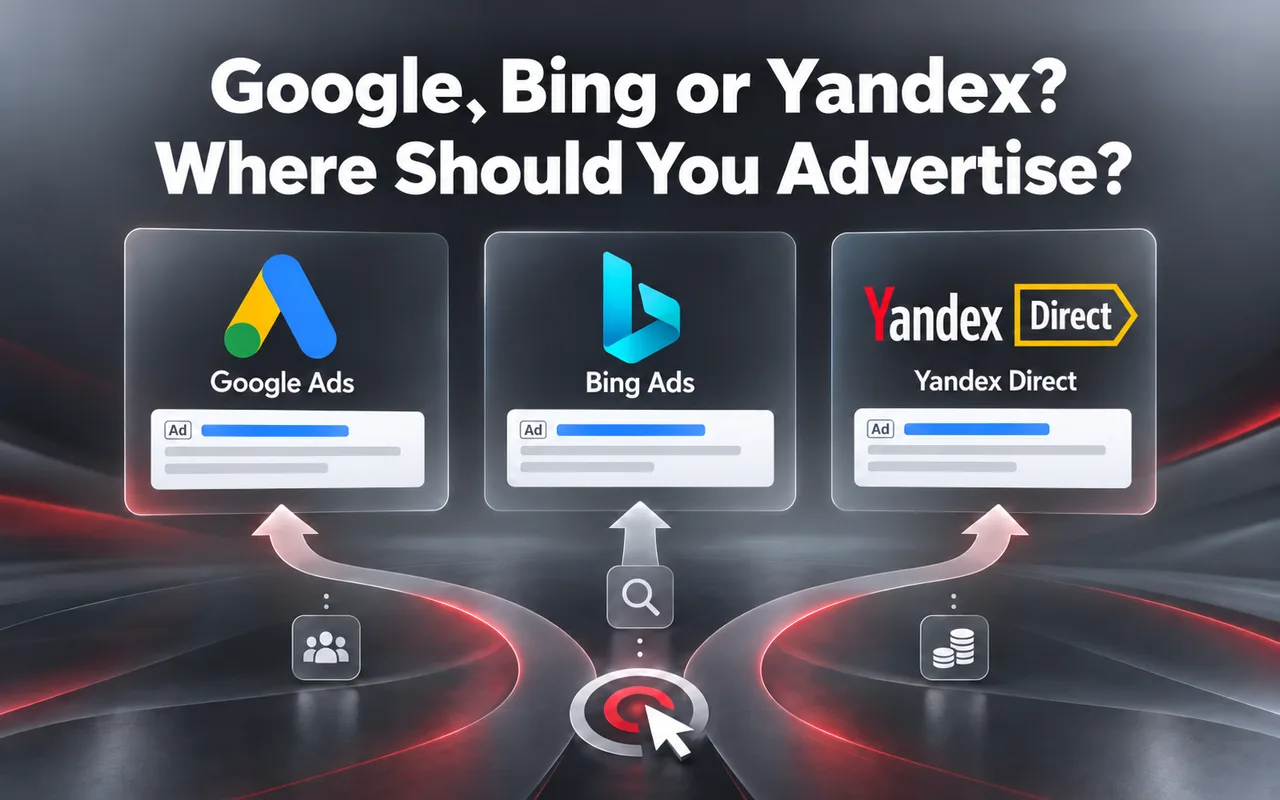
Google, Bing or Yandex: Where Should You Advertise?
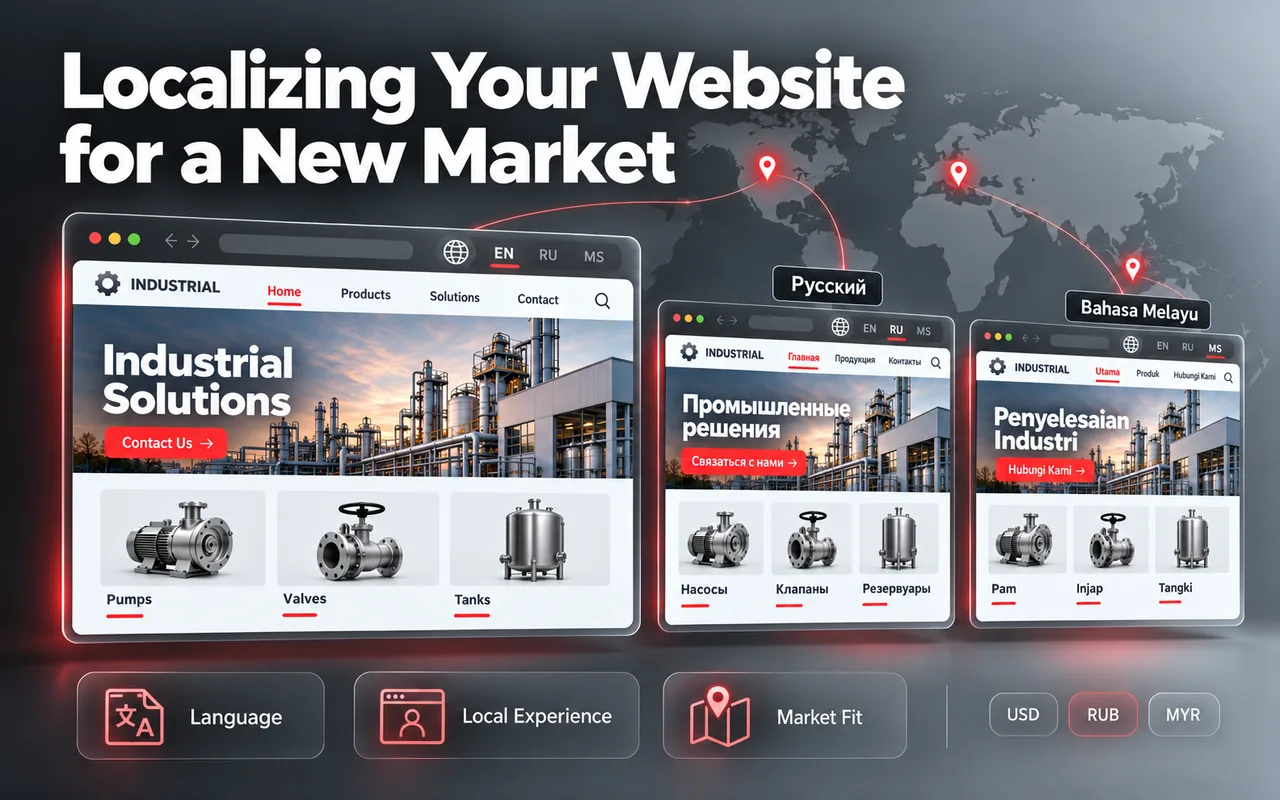
Localizing Your Website for a New Market